
Heritage and Access: Making Historic Places Inclusive
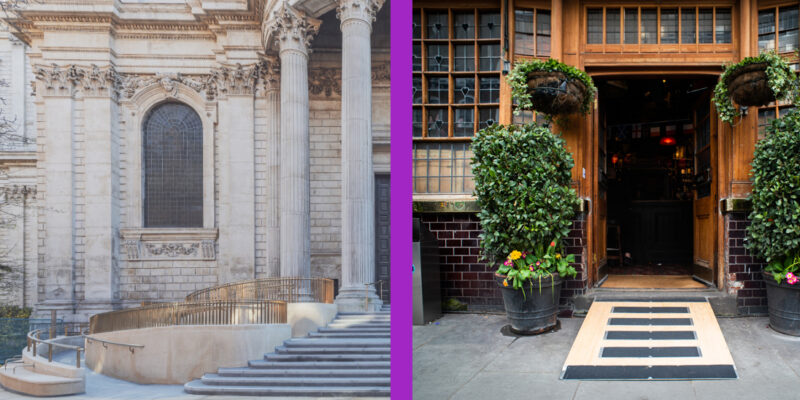
Heritage and access: we are not just talking about castles, cathedrals, or historic sites. It’s much broader.
Our new auditor Sam Yates writes:
My Journey into Heritage and Accessibility
After seven years working as a solicitor and 16 years of teaching history, I was ready for a new career challenge.
As a parent and carer for an older son with a degenerative neuro-muscular condition (requiring him to use a wheelchair since the age of 9), I was interested to explore ways in which I might be able to promote and encourage more accessible and inclusive spaces and experiences for disabled people (and their families and friends).
This was how I discovered the social model of disability, the role of access auditing and the world of inclusive design.
I was fully aware that the Equality Act created various legal rights and duties designed to prevent disability discrimination; but experience had taught me that, despite these rights and duties, the built environment all too frequently failed to create the accessible and inclusive experiences that disabled people deserved.
This was particularly the case for older buildings, apparently claiming some sort of blanket ‘heritage’ exemption or exclusion.
Becoming an Accredited Access Auditor
I sought out online training courses and invested a full year in re-training to qualify as an access auditor, accredited by the National Register of Access Consultants (NRAC), to equip myself for tackling this problem.
I offered my services as a volunteer access adviser on the Leeds Civic Trust’s planning committee and their Heritage Open Days group to gain further insight into the nature and extent of the challenge, with a particular focus on the constraints of conservation and heritage.
I also began to pick up freelance work carrying out access audits for a variety of different types of building and services (including schools, universities, sports centres and theatres).
The Challenges of Inclusive Design
Despite pockets of well-intentioned empathy and some examples of ambition and determination to exceed minimum standards, it appears that the existing planning system and the building regulations regime (even with the backing of the Equality Act) struggle to impose and embed consistently satisfactory levels of inclusive design in too many cases where new buildings are being built and where significant works are being carried out to existing buildings.
Disability Rights UK are currently campaigning for a new Accessibility Act to try and improve the legislative framework for accessible and inclusive standards.
Even if successful, this seems unlikely to deliver significant improvements anytime soon.
Working with Visits Unlimited in Calderdale
Through a mutual professional connection, I have been fortunate enough to be introduced to Katie Clarke at Visits Unlimited.
Katie and her colleagues and contacts have a wealth of experience of successfully promoting accessible heritage and culture throughout Calderdale (and beyond).
We are in the early stages of this partnership and looking forward to a good number of opportunities for us to collaborate on.
Our aim is to find creative solutions and provide disabled people (and their families and friends) with more and more genuinely accessible, inclusive and welcoming venues and events to engage with and enjoy.
Making Historic Buildings More Accessible
Whenever confronted with the lazy and ill-informed attempt to prioritise conservation and heritage as a blanket excuse to side-step access and inclusion, it is worth keeping in mind the clear and encouraging guidance on conservation principles set out in the guidance produced by the experts at Historic England:
“The survival of most historic buildings depends upon their continued, viable use and this may, among other things, require alterations to improve access.”
“There are only rare occasions when nothing can be done to improve or facilitate access . . . good quality solutions that add a new layer of history to our historic buildings are usually possible.”
Easy Access to Historic Buildings, Historic England (2015)
Heritage and Accessibility Beyond Castles and Cathedrals
Keep in mind that ‘heritage’ buildings are not just castles and cathedrals – the old village pub or hotel or cinema is just as likely to have an awkward single step entrance and limited accessible toilet facilities.
They might all make a legitimate case for conservation; and they should all be made to consider the case for satisfactory access and inclusion.
If you are aware of any heritage venues where access and inclusion deserve appropriate consideration, please get in touch!
Sam Yates, October 2026
Find Out More About Heritage and Accessibility
Visits Unlimited works with organisations, venues and communities to improve accessibility and inclusion through practical advice, training and access audits.
Find out more about our disability inclusion training and disability access audit services.
You can also contact Visits Unlimited to discuss making your heritage venue, building or organisation more accessible.